The app offers (but does not require) a Plex Pass In-App Purchase. Plex Pass is available for the equivalent of US$4.99 charged monthly to your iTunes Account, charged yearly for the equivalent of US$39.99, or as a one-off lifetime payment for the equivalent of US$149.99. My SMB file sharing on the same Mac at the Plex server works fine, so.
Facing problems when playing MKV files on Plex? loading forver or only video without audio? This tutorial will enable you play MKV files on Plex or via Plex Media Server smoothly.
(This article has been updated on 4,June,2018)
Plex: Your media on all your devices
Plex is a media player system and software suite comprising many player applications for 10-foot user interfaces, and an associated media server that organizes personal media stored on local devices. It organizes audio (music) and visual (photos and videos) content from personal media libraries and streams it to mobile devices, smart TVs, and streaming boxes.
What media formats are supported?
Plex announced that it supports wide range of media formats. If your device supports it, Plex will stream it directly. If it doesn’t, Plex will transcode it to an acceptable format for your device.
General Media Support
丨Video Support
Content matching the following can usually be Direct Played:
- Container: MP4
- Resolution: 1920×1080 or smaller ( PS3 has a max of 1280×720 )
- Video Encoding: H.264 (level 4.0 or lower)
- Audio Encoding: AAC
- Bitrate: 20Mbps or lower
丨Tip!: While content up to 20Mbps will be allowed and you can adjust your settings as such, exceeding the recommended 8Mbps setting may result in poor playback.
丨Music Support
The following audio formats are currently supported for music playback:
- MP3
- M4A
丨Other server supported audio formats (e.g. MP3, ALAC, FLAC, OGG, etc.) will be automatically transcoded for compatibility.
Plex App Cannot Find Server Macos
What about MKV videos?
If you have lots of MKV files and you want to play MKV files through Plex, you need know more:
1. “Plex not detecting MKV files”
“I have a diverse library of video files, many of them in mkv format. All other files play without problems but while transfer mkv files to Plex Media Server, it stops and go with buffering and reloading messages.”
In fact, MKV is just a container format, holding video, audio, image or subtitle files in it. The video and audio files in different MKV files can be encoded with different codecs. The Plex does not currently support Direct Playing all of MKV container videos. If the audio and video streams in the file are otherwise compatible, it will be Direct Streamed.
2. “Play MKV files via Plex no sound”
“I installed the Plex Home Theater on my Windows 7 PC. The PC is connected to the TV via HDMI, the audio output is connected to the audioreceiver via optical cable. I have a Plex server running on a separate PC. Everything was working fine untill I lost sound when playing MKV files. The MKV files I currently have shown up with no problem.”
That is to say, some of your MKV files with DTS audio, as Plex claim: DTS audio is not currently supported directly. Content with DTS audio will have the audio automatically transcoded to either AAC (default) or AC3 (if the Dolby Digital (AC3) receiver capability preference is enabled) by the Plex Media Server in order to preserve the surround sound audio channels.
Transcode MKV to Plex Compatible Video Format
To fix the issues, the easy option is to encode/re-encode the MKV videos to a more friendly format with Plex. Along with some help from third party programs, it can be done effortlessly. Here I will take Brorsoft Video Converter Ultimate (Mac Version) for instance to show you how to transcode MKV files for Plex streaming without any problem.
It’s a professional yet easy-to-use app which can help you convert MKV to Plex Media Server with MP4 format (the most compatible video format for Plex) without quality loss. In addition, it not only supports MKV videos, but also handles various common video formats, camcorder/camera recorded videos and downloaded video from website, like H.265 MP4, XAVC, XAVC-S/L/I, MXF. MTS, M2TS, MOV, MP4, AVI, WMV, FLV,etc.
P.S. There are many programs out there that allow us to transcode MKV files to Plex friendly formats. If you are seeking for the best video output quality, fastest video conversion speed, and the largest formats supported, Brorsoft Video Converter will be your best choice.
The trail-before-purchase quick download icon provide here, you can also click Brorsoft Video Converter Ultimate (Mac Version) turn to Brorsoft page for downloading.
Keep in mind that you have download the right version, Mac OS .dmg files cannot be installed on Windows platform – and vice versa.
Step 1. Load original MKV files
Click “Add” button on the main interface to load your MKV files to the program. (Drag&Drop function is included.)
Step 2. Select output format
Click “Format” and choose MP4 from “Common Video” as output format, which can be recognized by Plex easily. Here 3 H.264 presets “H.264 Baseline Profile Video(*.mp4)”, “H.264 Main Profile Video(*.mp4)”, “H.264 High Profile Video(*.mp4)” are supported.
Tips: With the right settings you can retain the quality of the original videos while also saving space. This is particularly helpful when streaming over your network, depending on your network quality. Simply click Settings bar and you can tweak the settings to your satisfaction and even save it as preset.
Step 3. Start MKV to Plex Conversion
Finally, hit the “Convert” button at the bottom of the main interface to start the conversion. It will automatically convert MKV to Plex Media Server compatible video files.
After the conversion, click “Open” to quickly find the converted movies. Then, Plex will recognize, catalog, play and stream these MKV files at ease.
Other Possible Ways to enable Plex read MKV files:
Solution 1: Make sure the whole file names were being recognized by Plex. For example, if all of my mkv videos are all Sports videos so the names, there were kind of random. To solve it, you can set ‘Scanner’ as ‘Personal Video Files Scanner’ and ‘Agent’ as ‘Personal Media’. Plex picks up pretty much any file with that setting.
Cons: I found it’s stuttering on large MKV files Plex.
Solution 2: Download Handbrake and use the default setting in it to convert MKV files to MP4 for streaming to Plex.
Cons: Some guys reflect Handbrake is spamware. Just downloaded it and had to do two malware cleans to get rid of all the shit it put on the computer.
It's been over 7 years that I've been running my Plex server off my trusty old 2011 Mac Mini. With it's SSD starting to fail, the time has come to retire it and move my Plex server to my new Synology DS918+, with an upgraded 8GB of RAM. With nearly a decade worth of watch history and friends who are using the server on the regular, it was key to not loose any of the history and libraries.
Given this would be the first time moving Plex from Mac to Linux, instead of Mac to Mac, the migration would require a bit more work. Luckily, I came across a great post by Mo_Gas on the Plex forums, making this process quite painless.
Prepare your Synology NAS
First, we need to get Plex up and running on your Synology NAS.
Install Plex Media Server on your NAS
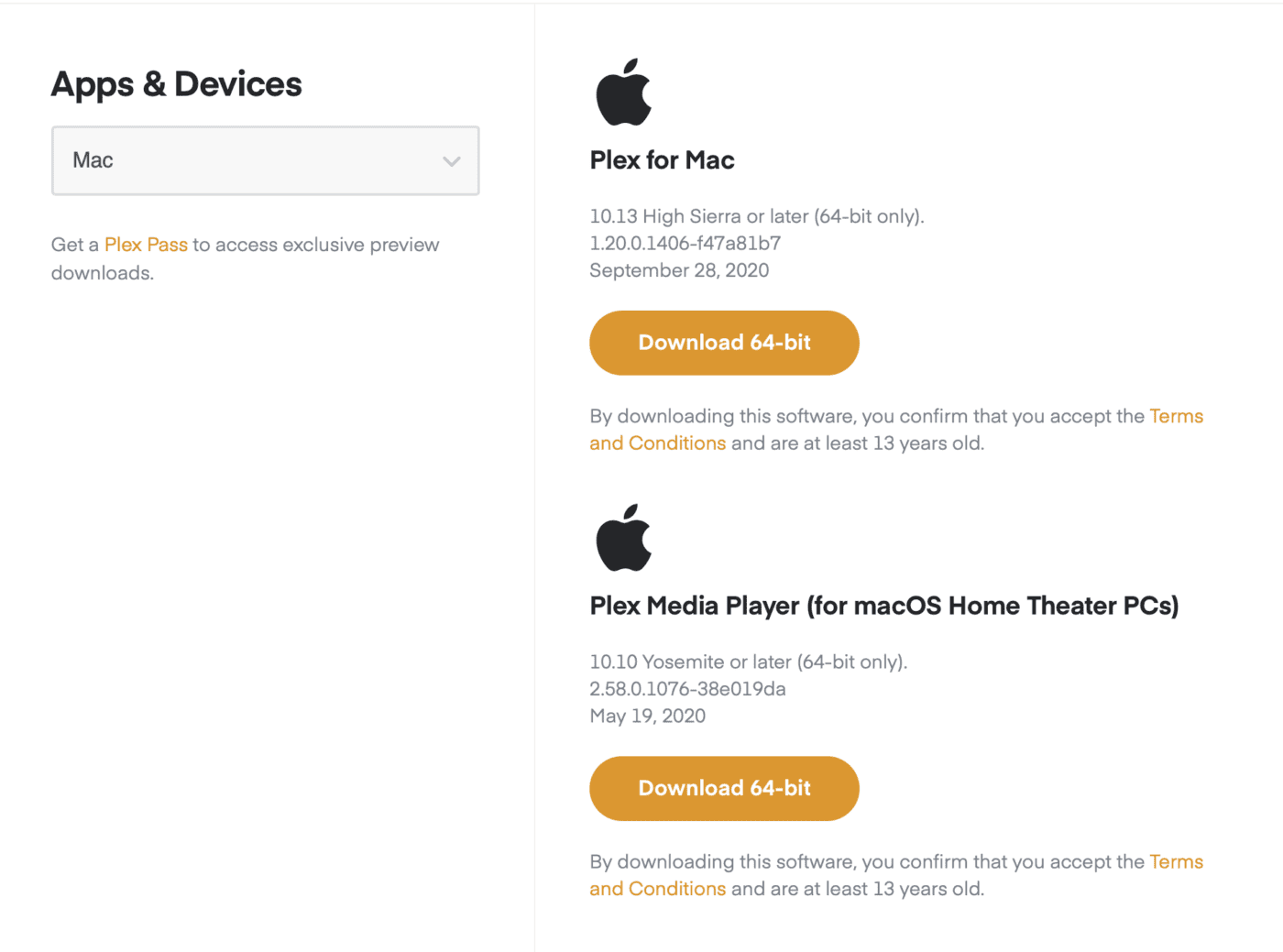
As I have a DS918+, thus an Intel based NAS, I wanted to make sure that I can take full advantage of hardware transcoding, so I downloaded the Intel 64bit PlexPass version from the Plex website.
I then proceeded to install this by going to the Package Center app and selecting Manual Install and selecting the file I just downloaded.
Configure your new Plex Media Server
With the installation of Plex Media Server completed, go through the setup wizard , but don't add any folders to any library. It is also key to make sure to disable empty trash and automatic library updates in the server's Library settings.
Stop PMS on Synology
With the new server initiated, it's time to stop it. Simply go to the Package Center, look for the Plex Media Server app and press Stop.
Your Synology NAS is now ready for you to import your existing Plex data.
Package up your Plex Server on your Mac
Now that your Synology is ready, it's time to get your existing Plex data off Mac.
Disable Empty Trash / Library Updates on your Mac.
As a first step, go to your existing Plex Server's configuration, under Library, once again disable Empty trash automatically after every scan and Scan my library automatically as well as Scan my library periodically. Save these changes.
Plex App Cannot Find Server Mac Os
Stop Plex Media Server
Simply stop your Plex Media Server on your Mac.
Optional - Transfer content
If you are storing your Plex content locally on your Mac, this is the moment where you may want to transfer it to your NAS. Keep in mind, that your content should be accessible by your Synology at the end of this.
Package up your Plex Media Server data
Time to pack it up! In a terminal window, package up your Plex Server data, excluding the Plug-ins folder, by running the following commands:
You can change the ./backup.tar.gz part of the command above to store your backup elsewhere besides the folder itself. I actually ended up saving it to a mounted drive on the NAS, allowing me to access it directly from the NAS.
In my case, the command above took several hours to complete due to the large amount of small files.
If you store it locally as per the command above, copy the backup.tar.gz file over to your NAS once the command completes.
Get your Plex Media Server identifiers
Now we need to make sure we get the Plex Media Server identifiers, so that we can have your new Synology Plex server maintain the same identity and shares.
Start with converting your Plex configuration file into a readable format by executing the following command in Terminal: plutil -convert xml1 com.plexapp.plexmediaserver.plist
Now open the com.plexapp.plexmediaserver.plist file in a text editor and look for MachineIdentifier and ProcessedMachineIdentifier entries and copy their value to temporary document. We'll get back to these later.
Restore your data on your Synology NAS
We've finally gotten to the step where we are restoring Plex onto your Synology NAS.
The easiest here is to do the following steps through SSH, however it's also possible to do this via the Synology Web Interface.
Extract your Backup, overwriting existing data
My Plex was installed on volume1 and I had copied the backup.tar.gz to my user's home directory, however you may have to slightly adapt the file paths in the commands below. Run them one at a time:
This will now start unpacking your data into your Plex Server directory. Once that's done, run the following command:
This will make sure your Plex Server has the correct access to these files.
Update the Plex configuration files
Now that your data has been restored, you'll need to restore the identifiers.
Open Preferences.xml under [PATH_TO]/Plex/Library/Application Support/Plex Media Server/. Look for the MachineIdentifier and ProcessedMachineIdentifier in that file and change values to the values you have copied from your Mac into your temporary document before.
Fire up Plex and clean up
Now that all your data has been restored and configured, you can fire up Plex. In Package Center, start the Plex Media Server app again.
Now you should be able to go to your Plex dashboard and find your Synology NAS with all the same data as your old Mac.
Add new Library folders
As your file paths for your library's data have changed, you will now have to go into every Library's configuration and add the new filepaths. Do NOT remove the old ones just yet.
Once you've done that for all your libraries, manually refresh all your Libraries. Double check if all your files are showing up in your libraries and are playing.
Remove old Library folders
Now that you have mapped all your folders again and refreshed your library, you can remove those old folder locations.
Now refresh your libraries once more.
Once that is complete, give your library another check. You may see some items with a red trash can. I'd recommend checking those items. In my case these were some files that had 2 paths originally that now only had 1, but always worth double checking.
Re-enable automatic updates and the trash
Now that all data has been restored, you can go back to the Library server configuration and re-enable automatic library updates and the Empty Trash functionality if you want to use those features.
Optional - Enable Hardware transcoding
The following step only applies to the Intel based Synology devices and PlexPass users. If that's you, I would highly recommend that you enable hardware accelerated transcoding.
For this, head to the Transcoder section in your server settings, hit Show Advanced at the top and select Use hardware acceleration when available.
This will enable hardware transcoding, which will significantly decrease your CPU load for video transcoding.
Closing
That is all! By now you have hopefully successfully migrated your Plex Media Server from your Mac OSX machine to your Synology NAS.
Personally, I've been very happy over the last few days with my DS918+, not really experiencing any issues when it comes to transcoding 1080p content.