Gantt Chart for Mac Mac users would agree that it is quite a chore to prepare software project Gantt chart examples and clear Gantt chart timelines using Mac OS. This is why using an online collaboration tool like Sinnaps may be the best option for Mac users who are constantly looking to build important visual plans like Gantt charts, update.
If you’re a project manager, you probably work a lot with Gantt charts. If not, let me explain:
Gantt charts are bar charts that represent the amount of work that needs to be done in certain chunks of time. They are ultimately used to visually lay out a project schedule. If you have a clear due date for your project with milestones in between, which is common for construction, textiles, and inventory strategy, you probably want to make use of these handy charts.
Unfortunately, Gantt charts are more complex than they initially seem. They are inefficient, if hand-drawn — no one wants to keep manually updating a moving chart as tasks are completed — and require skills in resource allocation, task-dependency management, and team collaboration.
That’s why I’ve gone through the extensive list of project management software that offers Gantt charts and selected the best.
Gantt chart software
What criteria did I use? First, I filtered through the Gantt chart software to make sure they offered an installed version for security reasons. From there, I opted for apps that could handle project planning, collaboration, and resource management. After that, I narrowed the list so that readers would be able to select the right suite for their business size; some companies might need enterprise project management software, but not all have to pay for it.
With that said, here’s the top Gantt chart software, sorted alphabetically.
1. Celoxis
Celoxis is a great option for large, global companies. It offers its services in multiple languages (Chinese, English, French, German, Portuguese, Russian, and Spanish) and has an impressive system for project portfolio management. Its notable clients include Deloitte, HBO, KPMG, LiveNation, and Xerox.
Celoxis has an impressive breadth of reporting options that pulls from Gantt chart information. While its resource allocation and project planning resources are the best, pay attention to how their reports can effectively analyze projected project costs (like resource hours, billable hours, and even product utilization) and how those projections compare to actual use. From there, project managers can learn how to improve their project management system internally.
One drawback is that Celoxis has very few integrations. Sure, it works with Microsoft Project, QuickBooks, Salesforce, and Google Apps, but offers little beyond that. However, Celoxis does offer an open API, so developers are constantly creating their own plug-ins to make Celoxis work best for them.
Price: $25 per user/month for web; $450 per user, one time (offers volume discounts) for installed version
Operating System(s): Linux, Mac OS X, Windows, Online
Company size: Large and enterprise
Used Celoxis? Leave a review!
2. Easy Projects
Easy Projects is best suited for companies with tons of outside clients. The Gantt chart software offers unlimited guest accounts, so your clients can follow their projects’ progress through to completion. It is available in French, German, Russian, and Spanish.
The nicest thing about Easy Projects is that it’s so easy to use. As one reviewer noted, “The software is suitable for ‘accidental project managers,’ meaning it does not use confusing industry jargon and is simple to learn to use, regardless of your project management experience.” Other user reviews confirm this sentiment — along with helpful customer service and overall functionality.
Easy Projects allows users to have both private and public calendars. Gantt charts are created with a simple drag-and-drop system, and project managers (accidental or not) can easily track and modify tasks, schedules, and dependencies.
I’d recommend Easy Projects to teams that are small in size, but need big project management features; large and enterprise companies can succeed with Easy Projects (as Toshiba, Staples, and UPS certainly have), but there may be similar options at a lower price point.
Price: Starts at $121 per user/month for web (paid annually and scales down per person with team size); $189 per user/year (offers volume discounts) for installed version
Operating System(s): Windows, Online
Company size: All, though better for smaller teams
Used Easy Projects? Leave a review!
3. Project Insight
If you’re a part of a growing company and are looking for a Gantt chart- based project management system that can scale from small to medium to large, check out Project Insight. Most of its clients are in the tech industry, like Dell and Cisco, and you can tell that it’s tailored its product to companies with a strong professional services program that want to have a project management system focused on tech resources and allocation.
Because it’s made for businesses with a range of projects, Project Insight gives project managers the ability to prioritize and sort different projects down to the granular level. They offer templates, time tracking, and a collaboration system, which allows users to comment on tasks, projects, and issues.
Users love Project Insight. One reviewer from Cardiff Consulting said, “I’d totally recommend this software to someone looking to understand where their efforts and money are going month to month.” In other words, if you’re a small business looking for the big picture or a big business looking for small details, Project Insight is likely a good investment for you.
Price: Starts at $3,900 per year for installed; starts from $10 per user/month for web
Operating System(s): Windows, Online
Company size: Mid-size
Used Project Insight? Leave a review!
4. RationalPlan
RationalPlan is a well-known Microsoft Project alternative that matches MS Project feature-to-feature — and it’s a lot cheaper to boot. One reviewer noted, “It doesn’t have the big brand name on it like MS Project, however, it offers superior performance and more functionality, in particular the possibility to schedule work at a percentage of someone’s time – a big gap in that big brand product. Customer support is really good and helpful, with knowledgeable staff.” It’s available in English, Dutch, and Italian.
RationalPlan has incredibly strong Gantt chart features. It has users start off by making a work breakdown structure to create task lists for your team. The whole system is drag-and-drop, and the system automatically highlights tasks that are along the critical path.
RationalPlan is particularly good for small businesses because it also offers budgeting features, like forecasting and cost management. While RationalPlan would work well with larger businesses, it doesn’t have that many enterprise clients… yet.
Price: Unpublished price for installed; starts from $19 per user/month for web
Operating System(s): Windows, Mac OS X, Linux, Online
Company size: Small to Mid-size
Used RationalPlan? Leave a review!
5. TeamHeadquarters
If you’re looking for Gantt chart software that also offers functionality for IT teams, look no further than TeamHeadquarters. This project management application is the intersection of help desk software, resource management software, and scheduling software.
One reviewer at Capterra summed it up: “It strikes a terrific balance between project management, time tracking, and support ticket control.”
If your IT team is struggling with communication, TeamHeadquarters offers an all-in-one solution so that you don’t need to jump from app to app for each project. It also has a customer service portal, so customer tickets can be scheduled alongside internal tickets. As you update your Gantt chart, everyone stays informed.
With all that said, software can’t be all the things. TeamHeadquarters does offer basic project management features, but it pales as a full solution compared to project management-specific software. For example, it’s missing some reporting and budgeting features.
Price: $499 User, one time fee for on-premise license; $24 per user/month for on-premise subscription; starts from $28 per user/month for web
Operating System(s): Windows, Mac OS X, Linux, Online
Company size: Small to Mid-size
Used TeamHeadquarters? Leave a review!
6. VisionFlow
You’ve gotten down to the last option on this article and might be thinking, “I like elements of all these options. I wish there was Gantt chart software where I could pick and choose functionality and pricing from each!”
Enter VisionFlow.
VisionFlow is modular software, meaning project managers and IT managers can choose its best modules.
VisionFlow offers the following modules:
- Help Desk Software and Customer Service Software
- Customer Relationship Management (CRM)
And of course:
The final module, which contains its Gantt chart functionality, also offers full project management capabilities. From resource allocation to budgeting to time tracking to reports, VisionFlow offers a viable project management suite for any serious manager.
VisionFlow is available in English, Swedish, German, French, Spanish, Norwegian, Czech, Russian, and Polish.
Price: Very flexible because it’s modular. The project management module costs $5.50 with a base price of $45 per user/month.
Operating System(s): Online, Windows
Company size: All
Used VisionFlow? Leave a review!
More?
There are certainly more amazing Gantt chart software options than the six listed above. Who did I miss? Do you like any of them? Let me know in the comments below!
Looking for Project Management software? Check out Capterra's list of the best Project Management software solutions.
This step-by-step Pages Gantt chart tutorial demonstrates how to make professional Gantt charts inside the popular word processor for Mac.
Mac users wanting to visually present plans or schedules in Pages can tweak a default 2D Stacked Bar chart to build a basic Gantt chart. Because formatting the graphic in Pages can become time-consuming, those who need to regularly create and update such visuals may find it simpler to use a dedicated Gantt chart maker instead.
This page will show you two ways to get your Gantt chart: either build it manually in Pages, or use the web-based Gantt chart maker called Office Timeline Online, which generates a professional visual automatically and lets you download it as a PowerPoint slide for easy sharing. If you wish to learn how to make a timeline in Pages for Mac, please see our timeline tutorial here.
Which tutorial would you like to see?
How to manually make a Gantt chart in Pages
1. Enter your project data into a table in Pages
Open Pages and double-click on Blank Landscape under the Basic category of the template gallery. This is recommended for an optimized layout of your presentation.
Add a table to your document by going to Insert → Table on the Pages ribbon or by clicking on the Table button on the taskbar above your page.
List the main phases or tasks of your project in the first row of the newly inserted table, as shown in the picture below. You'd keep their names short and concise to make sure they'll fit well on the graphic.
Use the second row to enter the start week for each of your project phases, setting the first task (which begins in week 1) as the reference point in determining the beginning of the remaining ones. See the following image for a better illustration of how I set the start time series for my chart.
In the third row of the table, add each task’s duration (amount of time required to complete that task) in weeks. Here are the calculations for my duration series:
Gantt Chart Maker
2. Add a 2D Stacked Bar Chart to your Pages document
Now that you have sorted out your data, you can start building your graphic.
Go to Insert → Chart on the Pages ribbon.
Click on 2D Stacked Bar from the menu that appears.
Pages will automatically generate a basic stacked bar chart that looks like this:
3. Input your project data into the chart
Select and copy (Cmd + C) all the rows of your project data table.
Click on the Edit Chart Data button that appears after selecting the chart area.
Select the first cell in the top-left corner of the Edit Chart window that shows up and paste the copied items. Pages will replace the placeholder data with your own and the graphic will be instantly updated to display the new details.
4. Turn your graphic into a Gantt chart
Now that that your chart has the right data in, you need to format it to make it look more like a Gantt. This means making the blue bars transparent so that only the green ones remain visible (these will represent the tasks of your project schedule). To do so, you need to select the chart area and:
Double-click on any of the blue bars of the graphic, which will select the whole series.
Go to the Style tab of the Format pane on the right side of the Pages document.
Click on the color indicator next to Fill and select No Fill.
The resulting graphic will look like the one below:
With your Gantt chart properly set up, you can now make further customizations to add meaning and help it stand out better.
5. Customize the tasks bars of your Gantt chart
If you want to recolor your tasks simultaneously, click on the chart area and then on any of the bars to select all of them at once. Then go to the Style tab of the Format pane and use the color indicator next to Fill to choose a new hue. In my example, I picked a pale blue.
Currently, your tasks are seen as a single series, and that's why you can edit them only all at once. To recolor your chart bars individually, your tasks need to be distributed in separate series, which will require you to:
i.Insert a few extra rows beneath Duration, which you can name Color 2, Color 3, Color 4 and so on. As you can see in the image below, the newly added lines will generate different hues for your graphic that you can further customize afterwards.
ii.Now, to move a task into a separate series or color category, cut its Duration value from its original row and paste it into one of the new lines, keeping the same column (the same goes for the rest of the tasks). Here is how I set up the new color palette for my graphic:
Note: As the image above shows, the tasks that have their Duration values on the same row are considered as a single series with the same color (e.g. Preparatory Phase and Testing Phase), which means they'll all be customized at once. The tasks with their duration values distributed on different rows are considered distinct series that can be customized separately - as shown in the following step.
iii.To further customize any of your task bars’ colors, double-click on the desired element and use the color indicator next to Fill on the Style tab to choose whichever new nuance you prefer. This is how I changed my Gantt chart's default colors:
While in the Style section, you may also want to apply a few effects such as strokes and shadows. Because I felt shadows were a little distracting and made the graphic more difficult to follow, I chose to add only a simple black outline to my task bars using the Stroke feature.
To display your tasks’ duration on the Gantt chart, select all the bars (Shift + Click), go to the Series tab, and choose Number from the dropdown menu under Value Labels. To change the placement of the value labels on the task bars, use the Location feature. In my example, I chose to have the labels displayed in the middle.
6. Customize the chart area
Once you’ve finished customizing the task bars, you can also make changes to the chart area of your graphic. Select it and use the features within the Chart and Axis tabs of the Format pane as follows:

Gantt Chart For Mac
Add titles and borders: Tick the boxes for Title and Border under Chart Options. I also unchecked Legend as I considered it redundant in my case.
Customize fonts: Use the options under Chart Font to modify the font type and size for the entire graphic. In my example, I changed the font from Helvetica Neue to Helvetica and I increased it a bit.
Note: You can customize the task descriptions or title independently by double-clicking on them and making the desired changes from the pane on the right.
Adjust the gap between the task bars: Use the up-down controls under Gaps to increase or decrease the space between chart bars. I increased it from 40% to 70% for my graphic.
Add more vertical lines to the chart: Click on the Axis tab of the Format pane, go to Minor Gridlines, and select the type of gridline you want to use. For my graphic, I used a straight grey line.
After carrying out all the steps above, trying out several font sizes, and increasing the size of the chart area, my Gantt chart looks like this:
Download Gantt chart template for Pages
How to make a Gantt chart online automatically
Apple's Pages does let you build a Gantt chart, but the formatting process can become cumbersome especially if you need to regularly create and edit such visuals for recurrent communications. Below I'll demonstrate how to make professional-looking Gantt charts more easily using Office Timeline Online.
Allowing you to automatically create an eye-catching graphic directly from your browser, Office Timeline also lets you update it quickly and download it as a .pptx file or .png image. To get things started, access the free online tool and carry out the following steps.
Gantt Chart App Mac
1. Add your project’s details in Office Timeline Online
Gantt Chart App Mac
To start building your Gantt chart, click on Timeline from scratch from the web tool's New tab or choose one of the templates available. In my case, I went for the first option, so you can see how to make a Gantt from top to bottom.
Selecting the Timeline from scratch option will open the Data View, where you can add and edit data.
Use the Data View tab to list your project’s tasks and their due dates and make a few styling choices such as choosing the shapes and colors of your items. Office Timeline will instantly transform this data into a graphic and display a live preview of it on the right. When you’re ready, open the Timeline View to see your graphic in full size and start customizing it. You can do this by either clicking on the preview image or selecting the Timeline tab above your data list.
2. Customize and update your Gantt Chart with ease
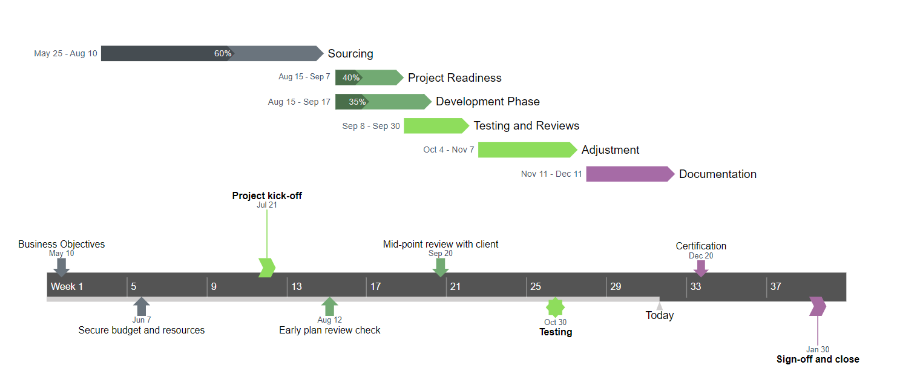
At this point, you can customize any detail on your newly created Gantt chart with just a few clicks. From the Timeline tab, you can change any color, shape and font, adjust the tasks' position and spacing, or choose to show details such as Task Duration or Percentage Complete. Whenever you want to add more tasks, you can instantly switch back to the Data View and enter their details. You can see on my final Gantt chart below that I have included some milestones too, which will help in tracking my project.
If you have a free Office Timeline Online account, the Gantt charts you make will be instantly saved in the cloud, which means you can return to them at any time and adjust them as plans change. The Timeline View lets you update task and milestone dates right on the graphic with a simple drag & drop, while the Data tab makes adding and editing items fast and easy. Once finished, turn your Gantt chart into an editable PowerPoint slide so you can easily include it in presentations.