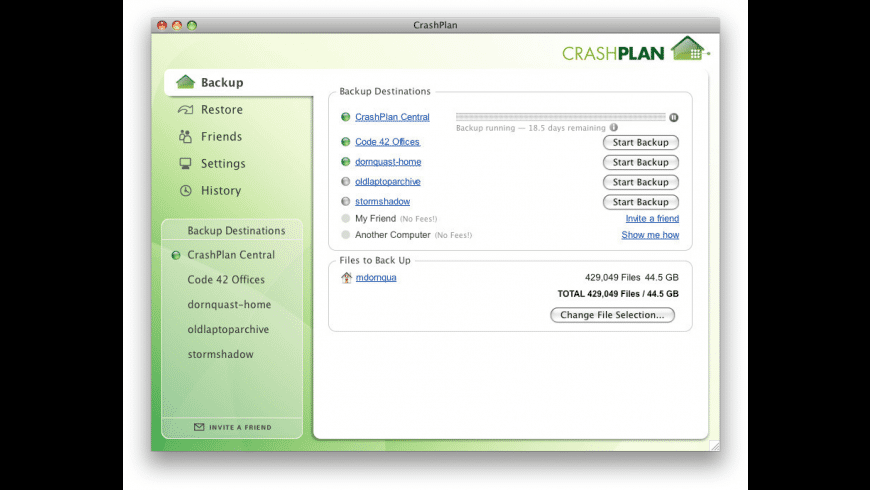
The easiest way to open the CrashPlan app is by searching for 'crashplan' on your Mac or Windows computer. Other ways to open the CrashPlan app: Mac: Find CrashPlan on the Task Bar. Windows: Find CrashPlan in the System Tray or Programs menu. The 7.2 version of CrashPlan for Mac is provided as a free download on our website. The following versions: 3.7, 3.6 and 3.5 are the most frequently downloaded ones by the program users.
Steps
Follow the installation instructions for your operating system:
Windows
- Download the version of the Code42 app for Windows provided by your business or organization.
- Code42 enterprise products: See your administrator for guidelines on downloading the Code42 app.
- CrashPlan for Small Business: Download the Code42 app from the Code42 console App Downloads screen.
- Double-click the EXE file, then click Next to begin the installation wizard.
- For Installation Type, click Next to accept the default setting, Everybody (all users).
The Code42 app will be accessible to all users on the device. Alternatively, if you have multiple user accounts on your device and want to back them up separately, see our guide on per user installation. - Sign in to your Code42 app.
Crashplan For Home Download
Mac
- Download the version of the Code42 app for Mac provided by your business or organization.
- Code42 enterprise products: See your administrator for guidelines on downloading the Code42 app.
- CrashPlan for Small Business: Download the Code42 app from the Code42 console App Downloads screen.
- Double-click the DMG file, then double-click Install Code42 (version 8.2 and later) or Install Code42 CrashPlan (version 8.0 and earlier).
- Follow the prompts to complete the installation using the default settings.
The Code42 app will be accessible to all users on the device. Alternatively, if you have multiple user accounts on your device and want to back them up separately, see our guide on per user installation. - Sign in to your Code42 app.
Linux
To install the Code42 app on Linux, run the install.sh shell script. For more detailed instructions, refer to the step-by-step information below.
- Download the latest version of the Code42 app for Linux.
- Code42 enterprise products: See your administrator for guidelines on downloading the Code42 app.
- CrashPlan for Small Business: Download the Code42 app from the Code42 console App Downloads screen.
- Extract the TGZ file to Downloads.
- Open Terminal and enter:
- Version 8.2 and later:
cd ~/Downloads/code42-install - Version 8.0 and earlier:
cd ~/Downloads/crashplan-install
- Version 8.2 and later:
- Press Enter.
- Then enter:
sudo ./install.sh - Press Enter to continue with installation.
- Advance through the remaining prompts by answering Yes or No questions.
Answer by typing a y or n, and press Enter. - The Code42 app opens after the installation completes.
- Sign in to your account.
Code42 apps on Linux typically require that you install the configuration package libgconf-2-4. If that package is missing, Code42's initial install alerts you, but an upgrade fails silently. To install the package, type the following in the terminal:sudo apt-get install libgconf-2-4
After you install libgconf-2-4, your Code42 app should work normally.
Dependency on libXScrnSaver
On Red Hat Enterprise Linux 7, the Code42 app requires the package libXScrnSaver. If that package is not present, the Code42 app installer prompts you twice for permission to install the package. We recommend you reply Yes to both prompts:
Without libXScrnSaver, the Code42 app service runs, but the app cannot open on desktops.
The log file /usr/local/crashplan/log/ui_error.log readserror while loading shared libraries: libXss.so.1
CrashPlan
Computer backup made simple.
Drobo5N releases
This DroboApps depends on the locale and java8 DroboApps. If you do not have firmware 3.3.0, please make sure they are installed or Crashplan will not start.
Please check the configuration page of CrashPlan in Drobo Dashboard for detailed instructions on how to redirect the CrashPlan client to connect with the Drobo.
Size: 36 MB
This DroboApps depends on the locale and java8 DroboApps. Please make sure they are installed or Crashplan will not start.
Please check the configuration page of CrashPlan in Drobo Dashboard for detailed instructions on how to redirect the CrashPlan client to connect with the Drobo.
Size: 25 MB
This DroboApps depends on the locale and java8 DroboApps. Please make sure they are installed or Crashplan will not start.
Please check the configuration page of CrashPlan in Drobo Dashboard for detailed instructions on how to redirect the CrashPlan client to connect with the Drobo.
Size: 25 MB
This DroboApps depends on the locale and java8 DroboApps. Please make sure they are installed or Crashplan will not start.
Please check the configuration page of CrashPlan in Drobo Dashboard for detailed instructions on how to redirect the CrashPlan client to connect with the Drobo.
Once logged in, if the folder selection screen shows the path /mnt/DroboFS/Shares, then congratulations, you have CrashPlan on your Drobo.
Don’t forget to secure access to your Crashplan installation by enabling password access in“Settings” > “Security” > “Require account password to access CrashPlan desktop application”
Size: 25 MB
This DroboApps depends on the locale and java8 DroboApps. Please make sure they are installed or Crashplan will not start.
To configure the CrashPlan engine you have to install the software on your machine, and redirect the GUI to connect with the Drobo. To do this, follow these steps:
- Edit the file:
/Applications/CrashPlan.app/Contents/Resources/Java/conf/ui.propertieson OSXC:Program FilesCrashPlanconfui.propertieson Windows/usr/local/crashplan/conf/ui.propertieson Linux
- Add the line:
serviceHost=xxx.xxx.xxx.xxx, replacingxxx.xxx.xxx.xxxwith the ip address of the Drobo, and save the file. - Edit the file:
/Library/Application Support/CrashPlan/.ui_infoon OSXC:ProgramDataCrashPlan.ui_infoon Windows$HOME/.crashplan/.ui_infoon Linux
- Edit the file to look like this:
4243,drobo. You can preserve the original.ui_infofile somewhere else, and restore it once you are done accessing CrashPlan on the Drobo.
Once logged in, if the folder selection screen shows the path /mnt/DroboFS/Shares, then congratulations, you have CrashPlan on your Drobo.
Don’t forget to secure access to your Crashplan installation by enabling password access in“Settings” > “Security” > “Require account password to access CrashPlan desktop application”
Size: 25 MB
This DroboApps depends on the locale and java8 DroboApps. Please make sure they are installed or Crashplan will not start.
To configure the CrashPlan engine you have to install the software on your machine, and redirect the GUI to connect with the Drobo. To do this, follow these steps:
- Edit the file:
~/Library/Application Support/CrashPlan/ui.propertieson OSXC:Program FilesCrashPlanconfui.propertieson Windows/usr/local/crashplan/conf/ui.propertieson Linux
- Add the line:
serviceHost=xxx.xxx.xxx.xxx, replacingxxx.xxx.xxx.xxxwith the ip address of the Drobo. - Save the file, and start the app. It will ask for the credentials to be used on the Drobo.
Once logged in, if the folder selection screen shows the path /mnt/DroboFS/Shares, then congratulations, you have CrashPlan on your Drobo.
Don’t forget to secure access to your Crashplan installation by enabling password access in“Settings” > “Security” > “Require account password to access CrashPlan desktop application”
Size: 23 MB
This DroboApps depends on the locale and java8 DroboApps. Please make sure they are installed or Crashplan will not start..
Crashplan App Download
To configure the CrashPlan engine you have to install the software on your machine, and redirect the GUI to connect with the Drobo. To do this, you need to establish a port forward from your desktop to the Drobo. Something like this should do the trick:
ssh -L 4200:localhost:4243 root@drobo-5n
Short explanation: this forwards any connection attempts to port 4201 on your machine to port 4243 on the Drobo. Once this is done, you have to tell the CrashPlan client to connect to port 4201 instead of the default (4243). To do this on a Mac, edit the file ~/Library/Application Support/CrashPlan/ui.properties and add this line:
servicePort=4200
Save the file, and start the app. It will ask for the credentials to be used on the Drobo. Once logged in, if the folder selection screen shows the path /mnt/DroboFS/Shares, then congratulations, you have CrashPlan on your Drobo.
More information about configuring a server over SSH can be found here.
Size: 23 MB
To configure the CrashPlan engine you have to install the software on your machine, and redirect the GUI to connect with the Drobo. To do this, you need to establish a port forward from your desktop to the Drobo. Something like this should do the trick:
ssh -L 4201:localhost:4243 root@drobo-5n
Short explanation: this forwards any connection attempts to port 4201 on your machine to port 4243 on the Drobo. Once this is done, you have to tell the CrashPlan client to connect to port 4201 instead of the default (4243). To do this on a Mac, edit the file ~/Library/Application Support/CrashPlan/ui.properties and add this line:
servicePort=4201
Save the file, and start the app. It will ask for the credentials to be used on the Drobo. Once logged in, if the folder selection screen shows the path /mnt/DroboFS/Shares, then congratulations, you have CrashPlan on your Drobo.
More information about configuring a server over SSH can be found here.
Size: 21 MB
Changelog: This version fixes several problems with service.sh, and reduces the maximum memory assigned to CrashPlan.
To configure the CrashPlan engine you have to install the software on your machine, and redirect the GUI to connect with the Drobo. To do this, you need to establish a port forward from your desktop to the Drobo. Something like this should do the trick:
ssh -L 4201:localhost:4243 root@drobo-5n
Short explanation: this forwards any connection attempts to port 4201 on your machine to port 4243 on the Drobo. Once this is done, you have to tell the CrashPlan client to connect to port 4201 instead of the default (4243). To do this on a Mac, edit the file ~/Library/Application Support/CrashPlan/ui.properties and add this line:
servicePort=4201
Download Crashplan App Mac Download
Save the file, and start the app. It will ask for the credentials to be used on the Drobo. Once logged in, if the folder selection screen shows the path /mnt/DroboFS/Shares, then congratulations, you have CrashPlan on your Drobo.
More information about configuring a server over SSH can be found here.
Size: 20 MB
To configure the CrashPlan engine you have to install the software on your machine, and redirect the GUI to connect with the Drobo. To do this, you need to establish a port forward from your desktop to the Drobo. Something like this should do the trick:
ssh -L 4201:localhost:4243 root@drobo-5n
Short explanation: this forwards any connection attempts to port 4201 on your machine to port 4243 on the Drobo. Once this is done, you have to tell the CrashPlan client to connect to port 4201 instead of the default (4243). To do this on a Mac, edit the file ~/Library/Application Support/CrashPlan/ui.properties and add this line:
servicePort=4201
Save the file, and start the app. It will ask for the credentials to be used on the Drobo. Once logged in, if the folder selection screen shows the path /mnt/DroboFS/Shares, then congratulations, you have CrashPlan on your Drobo.
More information about configuring a server over SSH can be found here.
Size: 20 MB
DroboFS releases
This DroboApps depends on the locale and java8 DroboApps. Please make sure they are installed or Crashplan will not start.
Please check the configuration page of CrashPlan at http://drobo.ip.address.here:8080/crashplan/ for detailed instructions on how to redirect the CrashPlan client to connect with the Drobo.
Size: 36 MB
This DroboApps depends on the locale and java8 DroboApps. Please make sure they are installed or Crashplan will not start.
Please check the configuration page of CrashPlan in Drobo Dashboard for detailed instructions on how to redirect the CrashPlan client to connect with the Drobo.
Size: 25 MB
This DroboApps depends on the locale and java8 DroboApps. Please make sure they are installed or Crashplan will not start.
To configure the CrashPlan engine you have to install the software on your machine, and redirect the GUI to connect with the Drobo. To do this, follow these steps:
- Edit the file:
/Applications/CrashPlan.app/Contents/Resources/Java/conf/ui.propertieson OSXC:Program FilesCrashPlanconfui.propertieson Windows/usr/local/crashplan/conf/ui.propertieson Linux
- Add the line:
serviceHost=xxx.xxx.xxx.xxx, replacingxxx.xxx.xxx.xxxwith the ip address of the Drobo, and save the file. - Edit the file:
/Library/Application Support/CrashPlan/.ui_infoon OSXC:ProgramDataCrashPlan.ui_infoon Windows$HOME/.crashplan/.ui_infoon Linux
- Edit the file to look like this:
4243,drobo. You can preserve the original.ui_infofile somewhere else, and restore it once you are done accessing CrashPlan on the Drobo.
Once logged in, if the folder selection screen shows the path /mnt/DroboFS/Shares, then congratulations, you have CrashPlan on your Drobo.
Don’t forget to secure access to your Crashplan installation by enabling password access in“Settings” > “Security” > “Require account password to access CrashPlan desktop application”
Size: 25 MB
This DroboApps depends on the locale and java8 DroboApps. Please make sure they are installed or Crashplan will not start.
To configure the CrashPlan engine you have to install the software on your machine, and redirect the GUI to connect with the Drobo. To do this, follow these steps:
- Edit the file:
~/Library/Application Support/CrashPlan/ui.propertieson OSXC:Program FilesCrashPlanconfui.propertieson Windows/usr/local/crashplan/conf/ui.propertieson Linux
- Add the line:
serviceHost=xxx.xxx.xxx.xxx, replacingxxx.xxx.xxx.xxxwith the ip address of the Drobo. - Save the file, and start the app. It will ask for the credentials to be used on the Drobo.
Once logged in, if the folder selection screen shows the path /mnt/DroboFS/Shares, then congratulations, you have CrashPlan on your Drobo.
Don’t forget to secure access to your Crashplan installation by enabling password access in“Settings” > “Security” > “Require account password to access CrashPlan desktop application”
Size: 23 MB
This DroboApps depends on the locale and java8 DroboApps. Please make sure they are installed or Crashplan will not start..
To configure the CrashPlan engine you have to install the software on your machine, and redirect the GUI to connect with the Drobo. To do this, you need to establish a port forward from your desktop to the Drobo. Something like this should do the trick:
ssh -L 4200:localhost:4243 root@drobo-fs
Short explanation: this forwards any connection attempts to port 4201 on your machine to port 4243 on the Drobo. Once this is done, you have to tell the CrashPlan client to connect to port 4201 instead of the default (4243). To do this on a Mac, edit the file ~/Library/Application Support/CrashPlan/ui.properties and add this line:
servicePort=4200
Save the file, and start the app. It will ask for the credentials to be used on the Drobo. Once logged in, if the folder selection screen shows the path /mnt/DroboFS/Shares, then congratulations, you have CrashPlan on your Drobo.
More information about configuring a server over SSH can be found here.
Size: 23 MB
To configure the CrashPlan engine you have to install the software on your machine, and redirect the GUI to connect with the Drobo. To do this, you need to establish a port forward from your desktop to the Drobo. Something like this should do the trick:
ssh -L 4201:localhost:4243 root@drobo-fs
Short explanation: this forwards any connection attempts to port 4201 on your machine to port 4243 on the Drobo. Once this is done, you have to tell the CrashPlan client to connect to port 4201 instead of the default (4243). To do this on a Mac, edit the file ~/Library/Application Support/CrashPlan/ui.properties and add this line:
servicePort=4201
Save the file, and start the app. It will ask for the credentials to be used on the Drobo. Once logged in, if the folder selection screen shows the path /mnt/DroboFS/Shares, then congratulations, you have CrashPlan on your Drobo.
More information about configuring a server over SSH can be found here.
Size: 21 MB
Changelog: This version fixes several problems with service.sh, and reduces the maximum memory assigned to CrashPlan.
To configure the CrashPlan engine you have to install the software on your machine, and redirect the GUI to connect with the Drobo. To do this, you need to establish a port forward from your desktop to the Drobo. Something like this should do the trick:
ssh -L 4201:localhost:4243 root@drobo-fs
Short explanation: this forwards any connection attempts to port 4201 on your machine to port 4243 on the Drobo. Once this is done, you have to tell the CrashPlan client to connect to port 4201 instead of the default (4243). To do this on a Mac, edit the file ~/Library/Application Support/CrashPlan/ui.properties and add this line:
servicePort=4201
Save the file, and start the app. It will ask for the credentials to be used on the Drobo. Once logged in, if the folder selection screen shows the path /mnt/DroboFS/Shares, then congratulations, you have CrashPlan on your Drobo.
More information about configuring a server over SSH can be found here.
Size: 20 MB
To configure the CrashPlan engine you have to install the software on your machine, and redirect the GUI to connect with the Drobo. To do this, you need to establish a port forward from your desktop to the Drobo. Something like this should do the trick:
ssh -L 4201:localhost:4243 root@drobo-fs
Crashplan Desktop App
Short explanation: this forwards any connection attempts to port 4201 on your machine to port 4243 on the Drobo. Once this is done, you have to tell the CrashPlan client to connect to port 4201 instead of the default (4243). To do this on a Mac, edit the file ~/Library/Application Support/CrashPlan/ui.properties and add this line:
servicePort=4201
Download Crashplan App Mac Ios
Save the file, and start the app. It will ask for the credentials to be used on the Drobo. Once logged in, if the folder selection screen shows the path /mnt/DroboFS/Shares, then congratulations, you have CrashPlan on your Drobo.
More information about configuring a server over SSH can be found here.
Crashplan Pro Download Client
Size: 20 MB